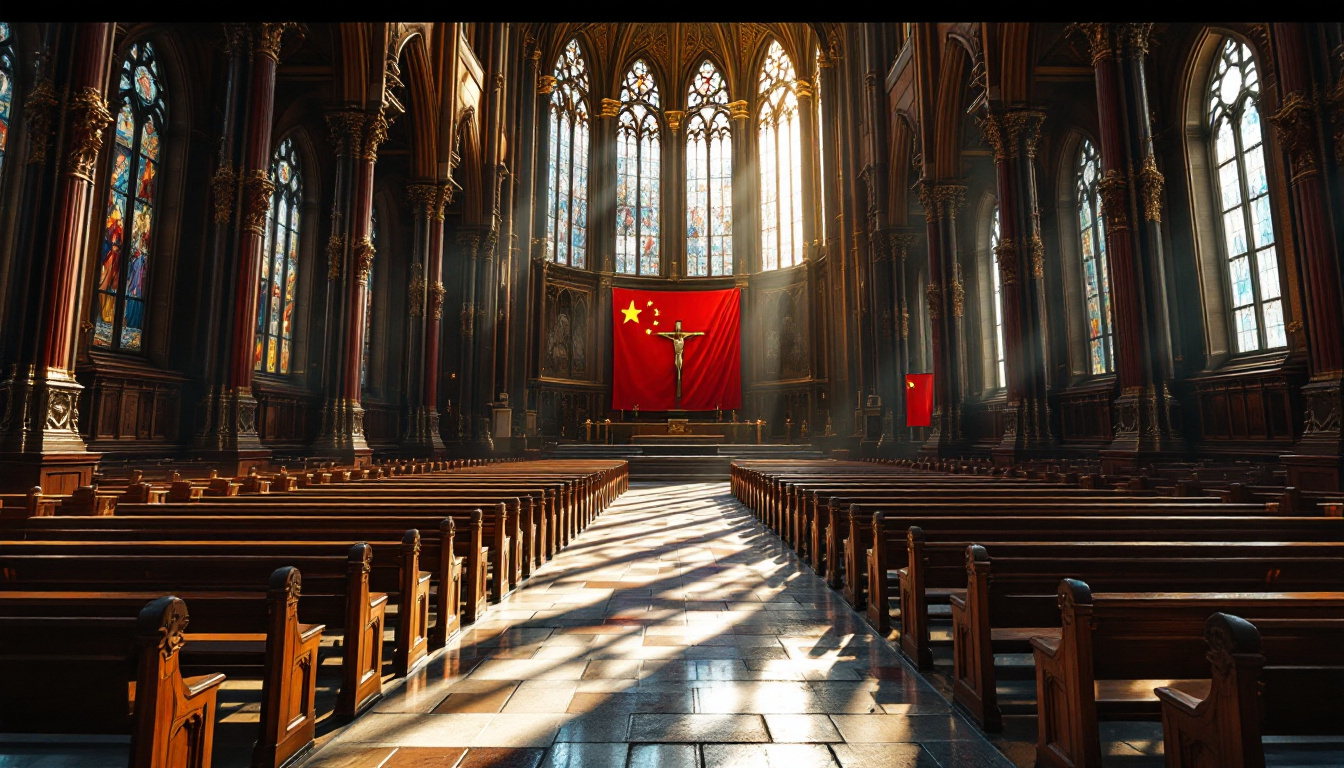
Last December, a Catholic church in China's Henan province was padlocked shut.
The notice on the door said the church had "violated relevant regulations by allowing minors to enter the church and play musical instruments." The children had been making music in church, and the Communist Party bans anyone under 18 from houses of worship.
The man who signed the order was a Catholic bishop, Francis Li Jianlin. As head of Henan's Committee for Catholic Ecclesiastical Affairs, he personally signed a directive banning all young people from church. One Chinese Catholic said the police aren't needed anymore, because the churchmen are doing their work for them.
That's what eight years of the Vatican's deal with Beijing has produced.
In 2018, the Holy See signed a provisional agreement with China on how Catholic bishops get appointed. The text has never been released. The Vatican has admitted that it gives the Chinese government a role in picking bishops, with the pope holding a veto. It has been renewed three times, most recently in 2024, for four years.
The same year the deal was signed, Xi Jinping began enforcing his "Sinicization" campaign against religion in earnest. Xi describes it as "adapting religion to socialism with Chinese characteristics." In practice, sermons must center on Xi Jinping Thought, religious and biblical teaching must conform to communist ideology, and houses of worship must keep out minors. Even the Bible is being retranslated under Party supervision.
The Party enforces this against Catholics through the China Patriotic Catholic Association. Mao created it to cut Chinese Catholics off from Rome. Members must pledge "independence, autonomy, self-management and democratic administration of the Church," which in plain language means renouncing the pope. In 2007, Pope Benedict XVI wrote that the association's "declared purpose" was "incompatible with Catholic doctrine."
In 2018, the Party moved the association under the United Front Work Department, the CCP's influence-and-control operation, and pressed every priest to join. The Vatican went along with it to save the deal, even though Rome still considers the association illegitimate.
Then the Party began installing the association's own leaders as bishops.
According to religious-freedom expert Nina Shea of the Hudson Institute, most of the 18 bishops appointed under the agreement are high-ranking officials in the association and its committees. So are two more bishops the pope approved as a Chinese precondition for signing. Here are some of them:
Joseph Huang voted as a member of China's rubber-stamp parliament to put Xi's Thought into the Chinese constitution. Pope Benedict excommunicated him in 2011 for being "illicitly" ordained. In 2018, to get the deal done, Rome lifted the excommunication and installed him in Shantou in place of Bishop Peter Zhuang, the bishop Rome itself had approved.
Vincent Zhan Silu was also excommunicated, and Rome lifted that excommunication as a precondition too. He replaced underground Bishop Vincent Guo, who was demoted, pressured to resign, and is now reportedly locked inside a church compound. In 2019, Zhan marched 33 of his priests to a socialism center for "reeducation." His words: "to carry out the Sinicization of religion with determination, we will continue to follow a path that conforms to socialist society."
Joseph Shen Bin is president of the association's bishops' council. In 2023, Beijing moved him to Shanghai, China's most important diocese, without asking Rome. Pope Francis approved the transfer three months after the fact. Vatican Secretary of State Cardinal Pietro Parolin said it was for "the greater good of the diocese."
Shanghai has a history with the association. Cardinal Ignatius Kung spent 30 years in prison for refusing to lead it. Bishop Thaddeus Ma has been held in solitary confinement at a seminary for 14 years for rejecting it. His predecessor, Bishop Joseph Xing, disappeared 15 years ago.
Shen Bin replaced them both, and his views are on the record. "We must . . . adhere to the principles of independence and autonomy in running the Church, adhere to the principle of democracy in running the Church, and adhere to the direction of the Sinicization of the Catholic Church in China," he told the diocesan magazine in 2023. "This is the bottom line, which no one can break, and it is also a high-pressure line, which no one should touch."
The appointments have continued under Pope Leo XIV, the first American pope. Last month, the agreement made 44-year-old parish priest Andrew Ding archbishop of Chongqing, a city of more than 30 million people. His main qualification is that he's vice secretary of the association's bishops' council. In Zhangjiakou, the new bishop is Joseph Wang, deputy director of the Patriotic Association in Hebei province. He replaced Bishop Augustine Cui Tai, who has been detained for years. The Vatican retired Cui Tai without saying whether he is free.
Ten bishops loyal to Rome have been detained, disappeared, demoted or forced out. Last year, Bishop Julius Jia died at a clinic in police custody. Three other elderly underground bishops have died the same way since the agreement was signed.
The church itself is shrinking. The Holy Spirit Study Centre in Hong Kong has estimated China's Catholics at 10 to 12 million for years, half of them underground. A 2023 Pew study found that "all available sources suggest that China's Catholic population is not growing." Purdue sociologist Fenggang Yang puts China's practicing Protestants at around 100 million, and their numbers are rising. Most of that growth is underground, in house churches the Party doesn't control.
The Vatican has stopped approving underground bishops, which are the part of the church that's still growing.
Rome's own missionary news service is already describing what comes next. On September 14, the Vatican's Fides agency ran an essay by a Chinese priest calling for a "Sinicization of Christianity" that goes beyond rules and institutions to become "a process of cultural creation, spiritual renewal, and dialogue among civilizations."
The Catholic Church has been in China for 400 years. Cardinal Kung chose three decades in prison over leading the Patriotic Association. Today its leaders are being made archbishops with Rome's approval. The agreement comes up for renewal in October 2028, and Pope Leo can let it lapse.