
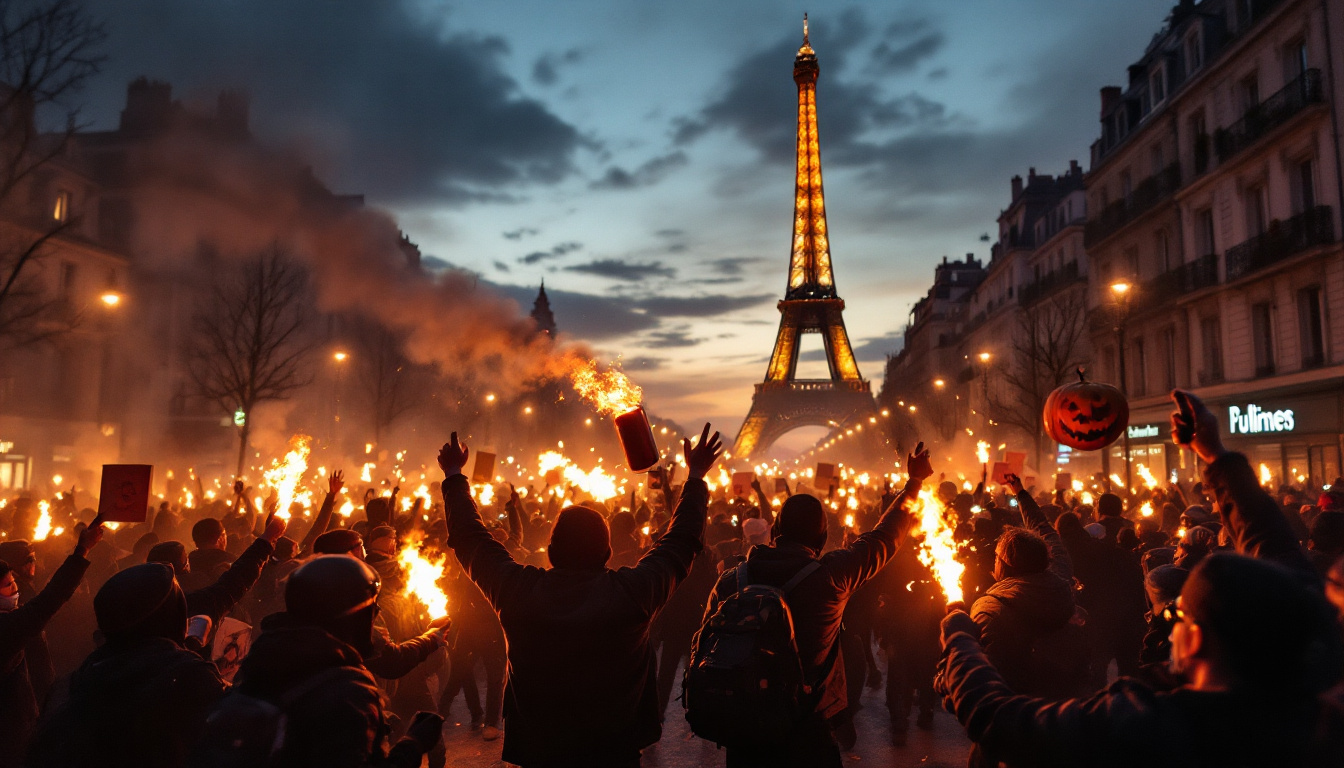
On Halloween night in Paris, a riot squad held the line at the Porte de Charenton, at the city's southeast edge.
Someone threw a Molotov cocktail into their ranks. It hit a gendarme's shield and set him on fire. His fellow officers beat out the flames, and the unit fell back. Nearby, dozens of masked men in black pried up paving stones with hammers and hurled them at police.
On Friday, Paris prosecutors opened an investigation for "attempted homicide of persons holding public authority."
"When you throw a Molotov cocktail at a police line, I call that attempted murder," said France's interior minister, Laurent Nuñez.
That was one corner of one city. By Sunday, France's Interior Ministry had counted 779 arrests nationwide and 159 police officers and gendarmes injured. Violence broke out in Bordeaux, Toulouse, Marseille, Rennes and Rouen, where the government said "radical elements" tried to push into city centers.
France saw it coming. It deployed 70,000 police and gendarmes across the country for one night, closed more than 40 metro and train stations near government buildings, and imposed an overnight curfew in parts of central Paris.
Nuñez didn't hide who he blamed. He described an "extraordinary" level of violence and pointed to far-left extremist groups. Before the night started, ultra-left websites had urged people to gather at 8 p.m., cover their faces, and use Halloween as cover to loot, vandalize and attack public buildings.
Plenty of them came in costume. Marchers in Paris dressed as clowns, witches, pirates, Spider-Man, Frankenstein's monster and a zombie Michael Jackson. French law fines people who cover their faces to disrupt public order. A Halloween costume solves that problem.
"Halloween," Nuñez said, "is not an excuse to break the law."
The night was the third day of nationwide protests that started with students angry about crumbling schools and university admissions, then grew as unions, "yellow vest" activists and opponents of President Emmanuel Macron piled on. It spread beyond France. In Frankfurt, Germany, police turned water cannons on young people throwing Molotov cocktails, and a regional official said about 100 known left-wing extremists had infiltrated the crowd.
France's right didn't hesitate. Former Interior Minister Bruno Retailleau called the firebombing "an attempted murder" and said whoever did it must answer for it. Marine Le Pen, who leads the polls for next spring's presidential election, said the attackers "must be found and punished with the utmost severity."
The hard left went a different way. Jean-Luc Mélenchon, its presidential candidate, joined the march in Paris and accused the government of turning authoritarian.
So on the night a police officer was set on fire, a leading candidate for president of France was marching with the crowd and blaming the government.
Americans have seen this playbook. Masked far-left militants, organized online, using a protest as cover to go after police and public buildings. It's the same pattern that led President Trump to designate Antifa a domestic terrorist organization last year.
Even Macron admitted it's "not normal" for France to be in this kind of turmoil so close to an election.
American kids spent Halloween sorting candy. In France, 159 police officers spent it getting hurt, and one of them spent part of it on fire.