
Rome police had 43 young people in custody before Saturday's marches even started.
During security checks, officers searched their bags and found balaclavas, gloves, masks, and keffiyehs. They seemed to know what kind of day it would be.
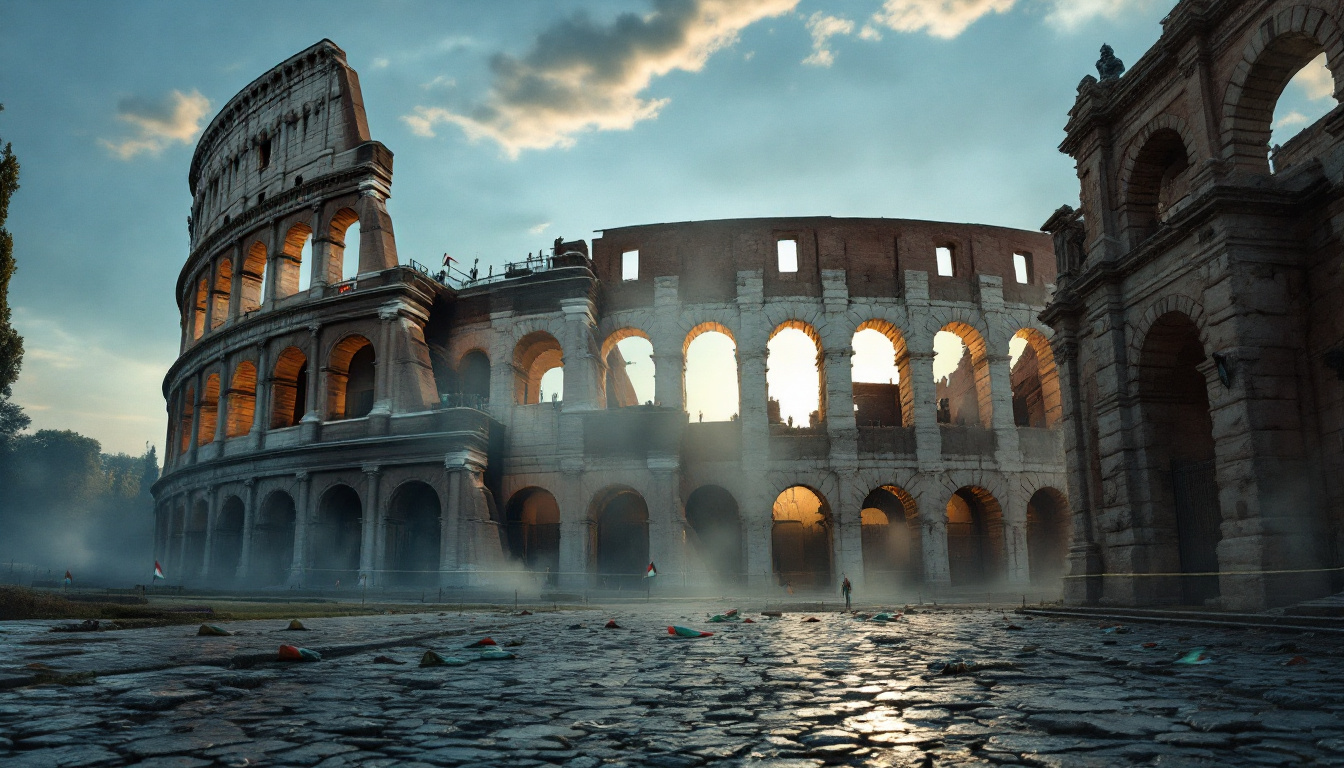
A few hours later, a group broke away from an anti-war march and headed for the Colosseum. Several hundred young protesters waving Palestinian flags got past security, reached the inside of the 2,000-year-old amphitheater, and cheered from the stands until security forces drove them out.
The Colosseum had been declared a security "red zone" last month after months of clashes with tourists. City officials put about 1,500 officers on the streets Saturday and had drones overhead. The mob got in anyway.
Once they were back outside, the protesters threw bottles and firecrackers at police. Officers answered with water cannons, tear gas, and charges. By the end of the day, police had taken 96 people in for questioning in Rome alone.
Across Italy, police identified more than 4,200 people. They brought 371 to police headquarters, and 110 of those were minors.
Milan was locked down. Ten thousand people marched through the city, where an antifascist march joined up with a pro-Palestinian one. Police used batons in Corso Venezia, the city's luxury shopping street. Demonstrators dumped manure outside Italy's energy regulator and set fire to a giant electricity bill. Store owners boarded their windows, remembering the looting that hit northern Italy just a week earlier.
Prime Minister Giorgia Meloni sent about 500 soldiers to back up the 5,000 officers already deployed in the city, and paratroopers stood guard around the Duomo cathedral. Defense Minister Guido Crosetto said the soldiers didn't carry pepper spray or Tasers, only plastic zip ties for arrests.
In Turin, protesters fired flares and threw bottles at police.
Investigators think they know who's behind it. On Saturday, Milan prosecutors arrested Youssef Siher, 30. They suspect he's the mastermind of the "October 17 Movement," the newly formed group that brought out much of the turnout. He's under investigation for incitement to commit crimes aggravated by terrorist purpose, and under Italy's new law against organized violence at public demonstrations. Police carried out more than 150 searches in Milan, Monza, and some 20 other cities. Siher is being held in Milan's San Vittore prison.
Meloni's government is answering with tougher penalties for minors, since police say young people are behind much of the violence. Justice Minister Carlo Nordio said Italy needs to "expand the capacity of our youth detention facilities."
Italy wasn't the only country burning.
France deployed about 70,000 police and security forces Saturday, after riots and looting the weekend before. More than 400,000 people turned out, and police arrested more than 1,300 of them. In Grenoble, authorities reported about 400 masked men dressed in black bloc gear attacking police with mortars. Interior Minister Laurent Nuñez blamed "individuals from the far-left and radical far-left" and called their actions "unacceptable."
In Barcelona, a gathering promoted on social media to bring the French youth movement to Spain ended in looting near Plaça de Catalunya. Police arrested 128 people, 72 of them minors. Fifteen officers were injured, four of them seriously. Rioters damaged or looted 23 businesses, and firefighters responded to 33 calls for burning dumpsters and street furniture.
In Albania's capital, rioters threw rocks at police and set fire to the door of the agriculture ministry. Riot police answered with tear gas, water cannons, and rubber bullets.
The Colosseum survived the fall of the Roman Empire. On Saturday, it held out for a few minutes.