
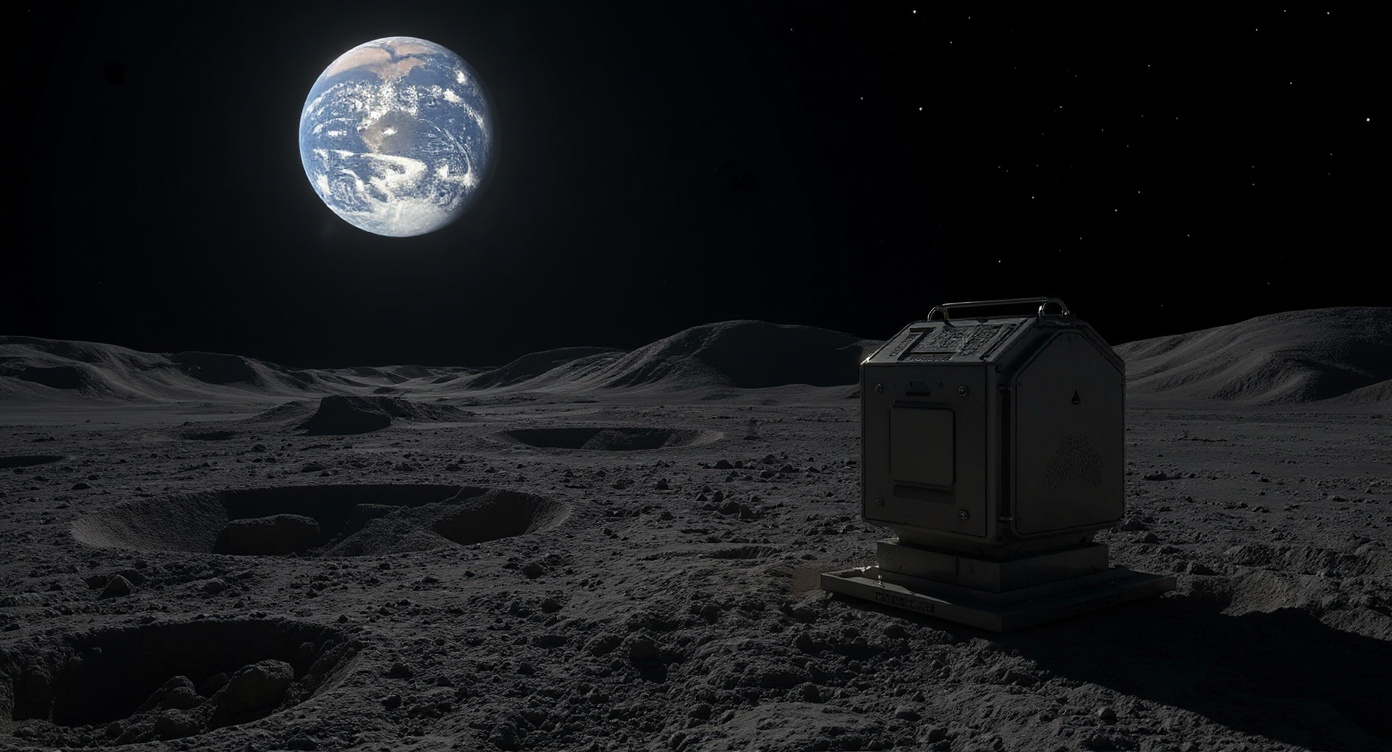
For about two weeks out of every month, the moon goes dark.
There's no sunlight, which means solar panels make no power, and temperatures crash hundreds of degrees below zero. Batteries die, and whatever was running on them dies too. Unless you have a power source that doesn't need the sun, a lunar base is a campsite you have to abandon every two weeks.
NASA plans to be the one with the power source.
The agency has asked American contractors to build Lunar Reactor 1, a nuclear fission reactor that has to survive the trip to space and then run near the moon's south pole for five years with nobody there to maintain it. The launch target is December 2030.
LR-1 is designed to put out 20 kilowatts of continuous electricity. On Earth, that would power about 16 houses. On the moon, it decides whether your base keeps running through the two-week night or shuts down. And it's only the first one. NASA expects later reactors to reach hundreds of kilowatts and eventually megawatt class.
Unfortunately, America is not the only country with this idea, it has competition. America's competition is a joint project between Russia and China built around a reactor called Selena. Selena is designed to produce up to 10 kilowatts, half of LR-1's output, and run on its own for a decade powering Chinese-led lunar stations. Its target completion date is 2036.
That's six years after ours.
Mikhail Kovalchuk, president of Russia's Kurchatov Institute, the agency behind Selena, has bragged that "Russia has practically no competitors in the field of space nuclear energy." NASA's calendar says otherwise.
The stakes are bigger than bragging rights. The moon's south pole holds frozen water in its permanently shadowed craters. That water can be drinking water, breathable oxygen and rocket fuel, which makes it the most valuable real estate off Earth. When NASA first ordered the reactor program fast-tracked in 2025, its directive spelled out what happens if a rival gets a reactor there first. That country could "declare a keep-out zone which would significantly inhibit the United States."
The same directive summed up the whole effort in one line: "It is about winning the second space race."
A few years ago, this was still a paper exercise. In 2022, NASA gave three companies $5 million apiece to draw up concept designs for a 40-kilowatt reactor, with no launch date. Then, in December 2025, President Trump signed an executive order on American space superiority. It called for Americans back on the moon by 2028 and a lunar outpost by 2030. Weeks later, NASA Administrator Jared Isaacman and Energy Secretary Chris Wright signed an agreement committing their agencies to a lunar surface reactor by 2030.
"Everything really we discussed today was in response to President Trump's executive order on American space superiority," Isaacman said when NASA laid out the plan in March.
The reactor is only one piece of that plan. NASA intends to launch a nuclear-powered spacecraft, Space Reactor-1 Freedom, toward Mars in December 2028. The data from that mission will feed directly into LR-1. NASA's moon base plan calls for roughly $10 billion per phase across three phases, with nuclear surface power arriving in the second phase.
Naturally, some people are nervous. Edwin Lyman of the Union of Concerned Scientists, a group that has spent decades as one of nuclear power's loudest critics, warned that "there will always be a space race going on, and if you enter nuclear power into that mix, then it could take a potentially more dangerous turn." His group has raised alarms about weapons-grade fuel. Space Reactor-1 Freedom, the reactor NASA is building first, runs on HALEU, a low-enriched uranium fuel that sits below weapons grade.
He also leaves out who else is in the race. Russia and China are already building a reactor for the moon. The real choice is whether America's arrives six years before theirs or sometime after.
China says it will land astronauts on the moon by 2030. NASA wants a reactor ready to launch that same year.
The date on the program is December 2030.