
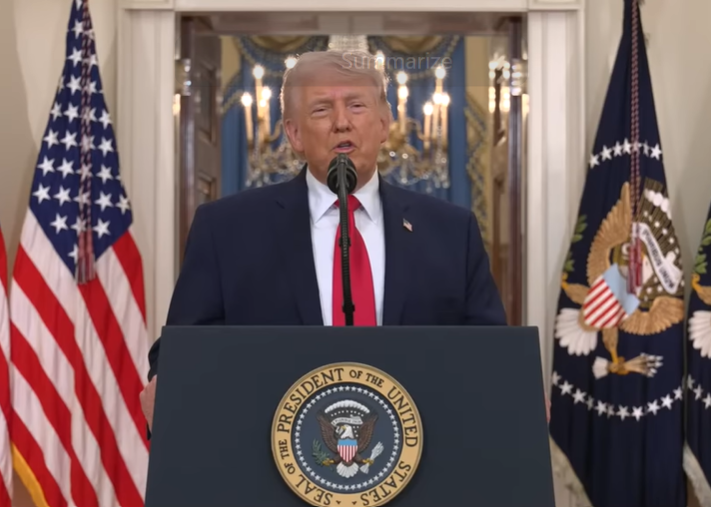
President Trump spoke to the nation for 25 minutes on Wednesday night about election integrity, declassified intelligence, and Chinese interference in American elections. ABC didn't air it. NBC didn't air it. CNN didn't air it. CBS broke in late, carried part of it, then cut away — shortly after Trump called for ABC and NBC to lose their broadcast licenses for refusing to show his remarks.
Fox News aired every minute.
All three broadcast networks then provided lengthy rebuttals.
That sequence is worth sitting with. The American public was offered expert commentary explaining why a speech was wrong — a speech most viewers on those networks never saw.
Here's the speech CNN, CBS, NBC and others didn't air
But there's a detail that makes it worse. Before CBS even cut to the speech, anchor Tony Dokoupil told his audience what to think about it: "Much of what the President has said on the security of American elections has been false." CBS declared the speech false. Then it aired seventeen minutes of it. Then it cut away.
That's not journalism. That's a verdict delivered before the evidence is read.
ABC's chief White House correspondent Mary Bruce told audiences, "We should stress this is complicated." Her colleague Rachel Scott added, "What the President presented tonight, it's complex." CBS correspondents Major Garrett and Tony Dokoupil concluded that Trump "inferred that there was still something problematic about the election when there was not."
Complex. Complicated. Problematic. Three networks, same thesaurus.
The decision to skip the address didn't come from some principled editorial standard — and we know this because of one data point. In April, when Trump gave a primetime address on the war with Iran, all three networks carried it live without hesitation. The same executives who decided Wednesday's speech wasn't worth airing made no such calculation about the Iran address. The difference wasn't the format. It wasn't the length. It was the subject matter. Election integrity. Chinese intelligence. Declassified documents the public was seeing for the first time. That's what the networks decided their audiences were better off not watching.
The decision also didn't happen in a vacuum. Rep. Alexandria Ocasio-Cortez publicly pressured the networks beforehand, arguing, "I don't think we should be contributing to any platforming of lies." NewsBusters analyst Jorge Bonilla reported that the networks effectively "kowtowed to AOC" — a socialist congresswoman from New York dictating the broadcast decisions of billion-dollar media companies.
ABC and NBC will point out that they aired the speech on their streaming platforms. This is technically true and practically irrelevant. Their broadcast audiences are their primary audiences — the people who have trusted those networks for decades, the people who aren't looking for a stream. Putting a presidential address on streaming while refusing to put it on broadcast is the equivalent of publishing a correction in six-point font at the bottom of page 14.
The post-speech analysis was revealing in its own right. ABC deployed Rachel Scott and Pierre Thomas. NBC sent Garrett Haake and Dan De Luce. CBS brought in Margaret Brennan of Face the Nation, who read a statement from a Chinese official claiming "China has never and will never interfere in presidential elections" — presented without visible skepticism, hours after 800 pages of declassified documents showed exactly that.
Read that again. CBS wouldn't air the declassified evidence of Chinese election interference. But it gave uncritical airtime to the Chinese government's denial of it.
Rachel Scott invoked the familiar talisman: the 60 court cases that challenged 2020 election results. That number has become the media's all-purpose shield against any discussion of election integrity, regardless of whether the subject is 2020 litigation or 2026 Chinese intelligence operations. The president cited 278,000 noncitizens registered to vote and 220 million voter records breached by Chinese intelligence. The networks addressed none of those specific figures. They addressed the speech they wished he'd given.
Here's the part the networks won't address directly: the material Trump presented wasn't his opinion. It was formerly classified intelligence, declassified specifically so the public could finally see it. The networks called it "claims" and "assertions" — language that implies the evidence doesn't exist. The evidence is 800 pages long and now public. When the FBI has classified briefings, the intelligence community has assessments, and those documents are released to the American people, calling it a "claim" is an editorial choice. It's a choice that tells your audience the documents aren't real.
White House communications director Steven Cheung was direct: "Cowards. NBC and ABC don't want you to hear the truth. All they want to do is hide the facts from YOU."
This happened 110 days before midterm elections, on a night when newly declassified intelligence was being presented to the American public for the first time. The networks made a collective editorial judgment — coordinated, in effect, by a congresswoman who publicly demanded they do so — that voters were better served by not seeing that material firsthand. Then they told viewers what to think about the material they'd just withheld.
You can decline to broadcast. You can broadcast and let viewers decide. What you cannot do with a straight face is refuse the broadcast and then tell your audience what to think about the thing you prevented them from seeing.
That's not news coverage. It's information management. And they're not even hiding it anymore.