
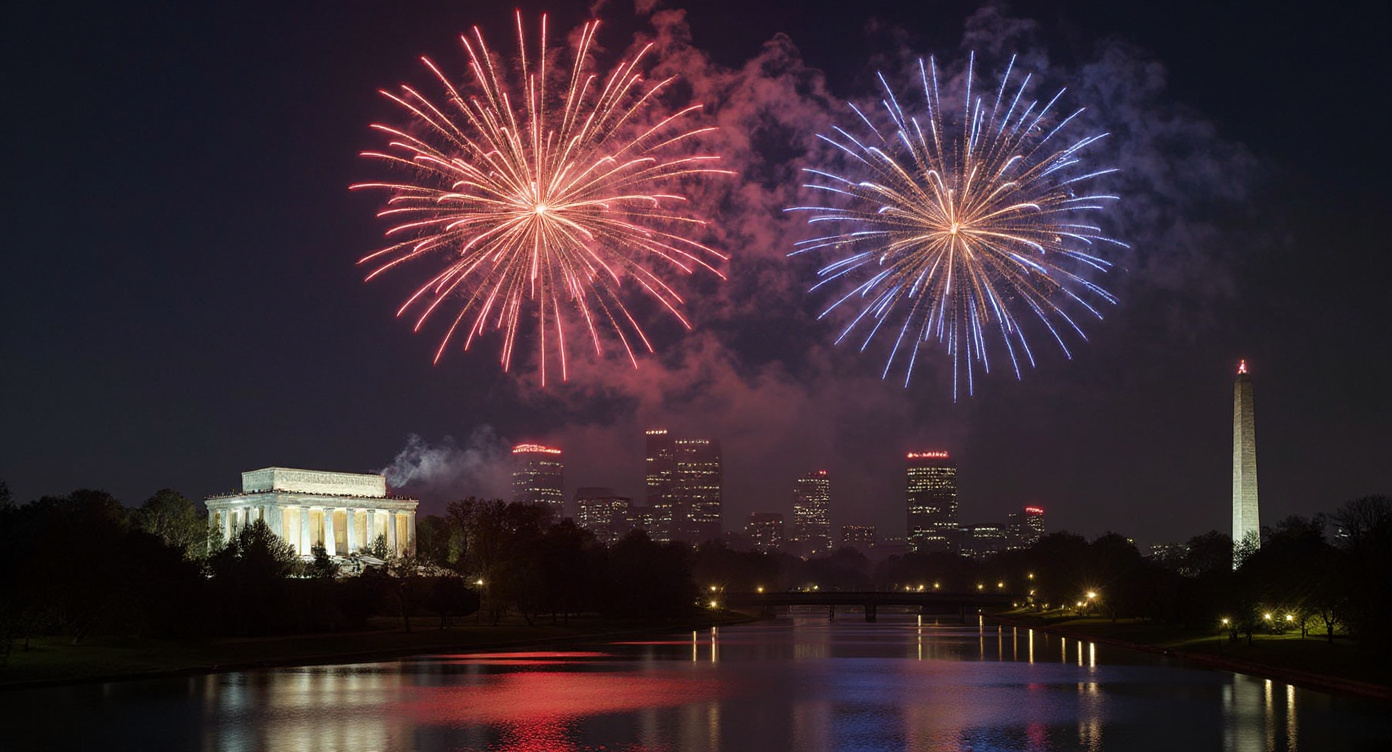
America turned 250 on Friday. Politico marked the occasion by publishing an article warning that the celebration might produce too much soot.
The headline: "Trump plans record fireworks show, internal docs warn of smoky skies." Happy birthday, America. Now let's talk about particulate matter.
Reporters Alex Guillen, Miranda Willson, and Ariel Wittenberg — it took three of them — produced a piece detailing the environmental toll of the nation's pyrotechnic birthday party. The article cited research showing that fireworks displays cause an average 42 percent increase in pollution, measured across 315 monitoring sites. Particulate matter, they reported, remains elevated for 24 hours after a display.
The timing of their sudden anxiety over pollution is no coincidence. Not a week before the Fourth. Not as part of a broader environmental policy series. On July 4th itself, while the rest of the country was lighting sparklers and singing the national anthem, Politico wanted you to know that the Potomac River was in danger.
The article went further. Pollutants from the fireworks concentrate in the Potomac, and a phenomenon called "tidal slosh" traps contaminants near Theodore Roosevelt Island. Perchlorates — a chemical compound released by fireworks — disrupt developmental processes in amphibians, juvenile fish, and ospreys during breeding season. Tyler Frankel, an associate environmental science professor at the University of Mary Washington, was brought in to add academic weight to the case against celebrating.
There was also a quote from an organizer with Moms Clean Air Force, because no Politico environmental piece is complete without a advocacy group with "Moms" in the name.
To be clear: fireworks produce pollution. So does driving to the fireworks show. So does the grill you fired up for hot dogs. So does the factory that made the flag you hung on your porch. At some point, the question stops being "does this activity have a measurable environmental impact?" and starts being "are you actually trying to ruin the Fourth of July?"
The answer, based on the evidence, is that Politico at minimum didn't mind if it did. Publishing a pollution complaint on the nation's 250th birthday isn't journalism — it's a genre. The genre is called "well, actually," and Politico has been its flagship publication for years. Every national celebration gets the treatment. Every moment of collective enjoyment gets footnoted with a reason you should feel bad about it.
President Trump's administration planned an expanded fireworks display for the semiquincentennial. Three Politico reporters responded by counting the soot particles. The 42 percent pollution spike across 315 monitoring sites was, in their framing, the real story of the day. Not the 250 years. Not the Declaration. The air quality index.
Somewhere out there, an osprey on Theodore Roosevelt Island watched the fireworks and didn't file a complaint. Politico filed one on its behalf.