
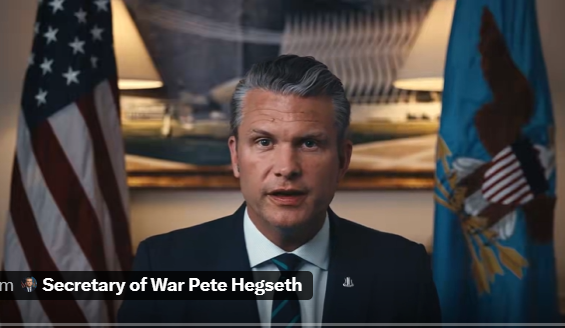
Secretary of War Pete Hegseth stood at a podium on Wednesday and announced that every service member over 30 will now undergo annual testosterone screening. Those who test deficient get testosterone replacement therapy. Those under 30 can volunteer for the same.
Somewhere at CNN headquarters, someone dropped their soy milk latte.
The program targets a well-documented medical reality. According to the data Hegseth cited, 5.6 percent of men aged 30 to 79 have clinically low testosterone — a condition linked to muscle loss, fatigue, weight gain, depression, cardiovascular disease, diabetes, and osteoporosis. For combat troops hauling 80-pound rucksacks through hostile terrain, those aren't abstract health concerns. They're mission-critical liabilities.
"While we invest heavily in our weapon systems, platforms and gear, our most decisive tactical advantage will always be the individual warfighter," Hegseth said. "We have a sacred duty to maintain that advantage, which is why we must constantly look for new ways to optimize your performance, your resilience and your long-term health."
The policy is straightforward medical screening — the kind the military already does for vision, hearing, cardiovascular fitness, and dental health. Hegseth was explicit that this isn't about juicing anybody up. "This initiative, it's not about artificial enhancement; it's about restoring and optimizing your natural capabilities," he said. Troops whose levels have dropped below clinical thresholds get treatment. That's it.
Hegseth framed the announcement under what he called "The High-T Department of War," because the man understands that branding matters. He wants service members to "have the right testosterone levels to operate at their absolute best because it's well-established science that as we age, testosterone levels often naturally drop." The science is settled. The endocrinology journals are stacked with decades of research on age-related testosterone decline and its effects on physical performance.
CNN's reaction was instantaneous and predictable. The same network that spent three years insisting we "follow the science" on everything from cloth masks to school closures suddenly discovered that endocrinology is controversial. The framing wasn't "Pentagon addresses documented health issue in aging troops." It was culture war panic — as if checking hormone levels is somehow ideological.
The previous administration's Pentagon spent its energy on DEI training modules, pronoun guidance memos, and drag shows on military installations. Readiness metrics declined. Recruiting numbers cratered. The people responsible for those priorities never got the CNN treatment. Nobody called diversity seminars "controversial." Nobody asked whether mandatory unconscious bias training was an appropriate use of Defense Department resources.
Hegseth's Pentagon identified a measurable, treatable medical condition that directly affects combat readiness and announced a screening program to address it. The clinical literature supports it. The operational logic is obvious. The troops who benefit from it will be stronger, more resilient, and more capable.
The opposition to this policy requires believing one of two things: either the Pentagon shouldn't screen for known medical deficiencies in its fighting force, or testosterone specifically is too politically loaded to treat. The first position is indefensible. The second tells you everything about who's actually making this political.