
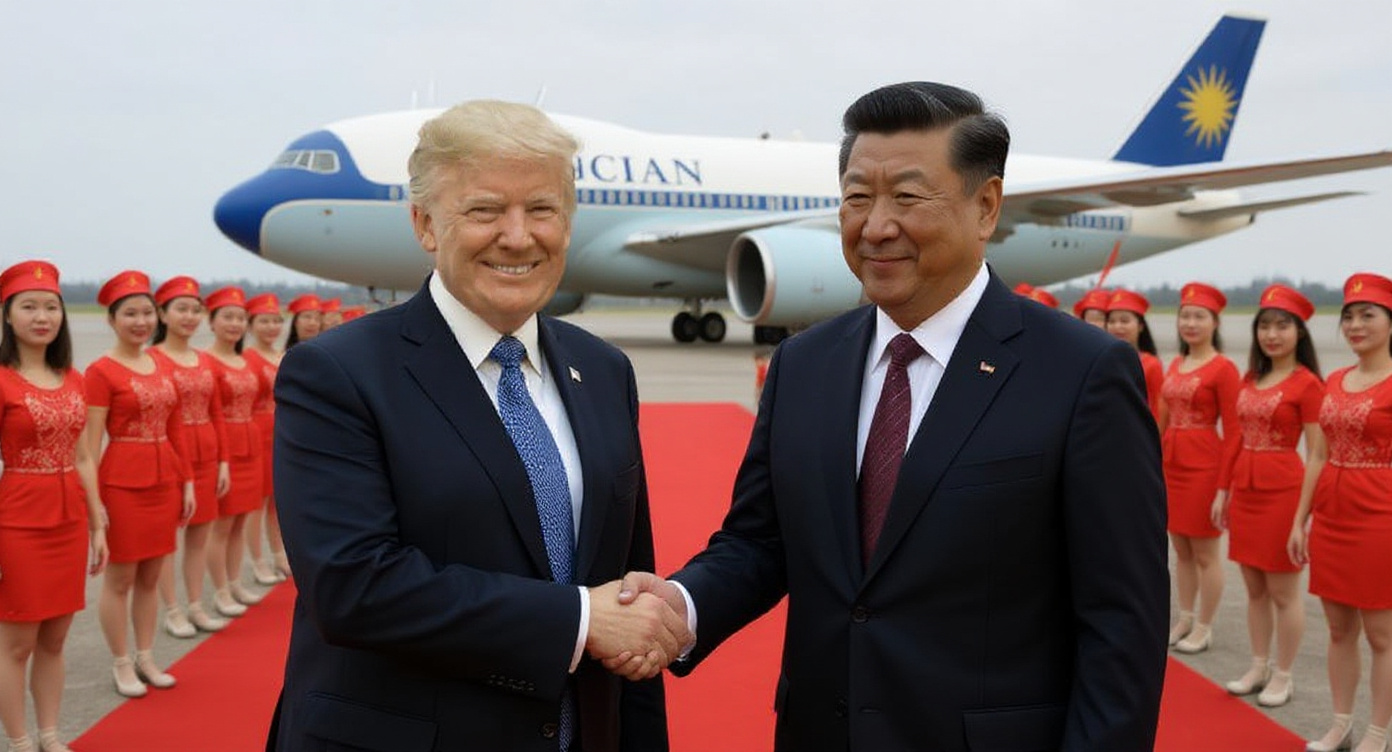
A handshake at the foot of Air Force One's stairs turned into a hug Wednesday morning in Shenzhen, China. President Xi Jinping — a man not known for public physical gestures with any world leader — walked down a red carpet lined with young people waving American and Chinese flags to personally greet President Donald Trump the moment he stepped off the plane.
It was the first time in more than a decade that Xi had personally received a foreign dignitary at an airport.
Rows of military regiments stood at attention. Performers in bright pink and turquoise outfits flanked the carpet. A young girl stepped forward and handed Trump a bouquet of flowers. The whole production was China doing what China does when it wants the world to notice: signaling, loudly, that the man walking off that plane matters more than anyone else on the guest list.
And there was a guest list. Russian President Vladimir Putin arrived in Shenzhen earlier Wednesday for the same Asia-Pacific Economic Cooperation summit and the same trilateral meeting scheduled for Thursday at the Qilin Villa. Putin was greeted by Cai Qi, a member of the Chinese Communist Party's Politburo Standing Committee and a longtime Xi deputy. Senior party official. Not the president of China standing on the tarmac.
Trump got Xi. Putin got Cai Qi.
The gesture was a direct reciprocation. Back in September, Trump broke with standard presidential protocol by personally greeting Xi at the airport when the Chinese leader arrived in Washington for a state visit. Trump had told reporters in the weeks before that he was delighted his new helicopter landing pad would be ready for the occasion — he wanted to put on a show. Xi noticed. Two months later, standing on a runway in Shenzhen, he returned the favor in a way no Chinese president has done for a visiting American leader in over a decade.
The APEC summit itself carries a loaded agenda. A senior Trump administration official told Reuters that a new nuclear treaty would "start the conversation" at Thursday's trilateral meeting but that "we do not expect to get any kind of agreement." Trump's stated priority is pulling both China and Russia into a new nuclear proliferation framework — the kind of three-way negotiation that previous administrations talked about pursuing and never actually arranged.
Kremlin spokesman Dmitry Peskov called the trilateral meeting "extremely significant." That's diplomatic language, but Peskov doesn't attach that phrase to meetings Russia considers performative. Three nuclear powers at one table, with Trump at the head of the arrangement, is the kind of positioning the foreign policy establishment spent four years insisting couldn't happen.
Back home, the same people who spent November 2024 through January 2025 calling Trump an authoritarian who would isolate America from the world are watching the leader of the world's second-largest economy physically embrace him on a runway. Xi Jinping doesn't hug people. He shook hands with Joe Biden at the 2023 APEC summit in San Francisco from across a mahogany table in a room that looked like a corporate mediation. The imagery from Shenzhen is a different category entirely.
The contrast between the tarmac and the cable news chyrons is the whole story. Democrats spent two years warning that Trump's approach to China would start a trade war, collapse diplomatic relations, and leave America isolated. What actually happened: Trump imposed tariffs, renegotiated trade terms, and the Chinese president flew performers to an airport to greet him with flags and flowers.
Putin arrived first. Xi sent a deputy. Trump arrived second. Xi came himself.
The trilateral summit at Qilin Villa convenes Thursday.