
Another win for the American worker and jobs, thanks to President Trump. Today marks the first day that President Trump’s restructured tariffs on steel, aluminum, and copper officially go into effect. Products made almost entirely of these metals now face a flat 50% tariff on their full customs value. Derivative products that are substantially made of the metals get hit with 25%. And certain industrial and electrical grid equipment slides in at 15% through 2027. The message from the White House couldn’t be clearer: if you want to sell metal in America, you’d better be making it in America.
Cue the chorus of economists clutching their textbooks and explaining why this is a disaster. The same economists who told us NAFTA would lift all boats, free trade with China would democratize the CCP, and globalization would make everyone rich want you to believe that forcing the steel industry to come back to America and hire more Americans is somehow bad.
Here’s what Trump’s proclamation actually does, and why it matters more than the talking heads want you to think.
The old Section 232 tariffs — the ones Trump imposed in his first term and maintained through his second — had a loophole problem. Companies figured out they could import products that were 80% steel but classified as “machinery” or “equipment” and dodge the metals tariff entirely. A steel coil got the tariff. A piece of equipment made almost entirely of steel coils somehow didn’t. It was the kind of regulatory arbitrage that makes trade lawyers rich and steelworkers unemployed.
The new rules close that gap. If your product is made almost entirely of aluminum, steel, or copper — and the Commerce Department has been very specific about what “almost entirely” means — you pay 50% on the full value. Not on the metal content. On the full value. That’s a big deal, because the old system let importers game the valuation by declaring a low metal percentage and paying tariffs only on that fraction.
There’s also a smart carve-out that nobody’s talking about. Products manufactured abroad but made with 100% American-sourced steel, aluminum, or copper face a reduced 10% tariff. So if a Canadian company buys American steel, fabricates it into beams in Ontario, and ships them back — they pay 10% instead of 50%. That rewards companies for buying American raw materials even when they assemble overseas. It’s not perfect, but it’s a lot smarter than a flat tariff that penalizes our own supply chain.
Another provision exempts products with 15% or less metal content from the Section 232 tariffs entirely. Your toaster that happens to have a steel heating element? Not affected. The Chinese-made steel beam that’s 98% metal? Absolutely affected. The tariff targets the imports that actually compete with domestic production, not every product that touches a piece of aluminum.
Now, the critics. And there are many.
The National Taxpayers Union — which we generally respect — released a report timed to the one-year anniversary of Liberation Day arguing that tariffs have “handcuffed” U.S. farmers and manufacturers. They point to the fact that manufacturing employment fell by 100,000 jobs between January 2025 and early 2026. They note that manufacturers hired 388,000 fewer workers in 2025 than in 2024. They cite the ISM Manufacturing Index, which showed nine consecutive months of contraction after Liberation Day.
Fair points. But incomplete ones.
What the NTU report doesn’t mention is that the manufacturing contraction coincided with a global economic slowdown driven by the Strait of Hormuz crisis, which we’ll get to in another article. It doesn’t mention that the sectors hit hardest — automotive and electronics — were contracting before the tariffs due to EV transition costs and semiconductor supply chain disruptions. And it doesn’t mention that the sectors the tariffs were specifically designed to protect — primary metals, steel fabrication, and aluminum production — have actually added 31,000 jobs since April 2025.
That’s not nothing. Thirty-one thousand families with paychecks in an industry that was supposed to be dead.
The USTR’s own anniversary report shows the overall U.S. goods trade deficit decreased 24% from April 2025 through February 2026 compared to the same period a year earlier. Imports from China dropped by 38%. Imports of steel specifically fell 22% while domestic steel production rose 8%. Those aren’t talking points. Those are Census Bureau numbers.
Did tariffs solve every problem? Obviously not. The overall goods trade deficit still hit an all-time high in calendar year 2025 because the tariff reductions from trade deals didn’t kick in until later in the year. Consumer prices on certain imported goods went up. Some downstream manufacturers ate higher input costs. Trade policy is messy. It always has been.
But here’s what we know for sure: before the tariffs, China was dumping steel into our market at below-production-cost prices, driving American mills out of business, and then raising prices once the competition was dead. That’s not free trade. That’s predatory economics. And the only tool that stops it is the one Trump just sharpened.
The 50% rate is aggressive. It’s meant to be. It tells every steel mill in Pittsburgh, every aluminum smelter in Kentucky, and every copper refinery in Arizona: this administration will not let foreign governments subsidize your competitors into oblivion.
Will some prices go up? Yes. Will some importers complain? Loudly. Will the editorial board of the Wall Street Journal write another hand-wringing column about Smoot-Hawley? They probably already have.
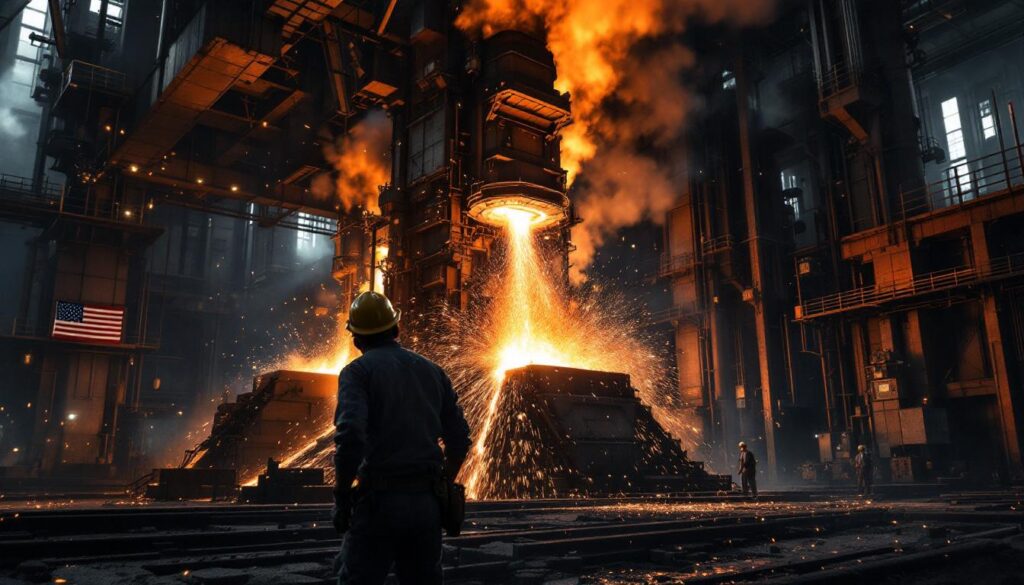
But somewhere in the Mon Valley, a blast furnace is firing up that was cold two years ago. And the guy running it doesn’t read the Wall Street Journal. He reads his paycheck.
That’s the trade-off. We’ll take it.