
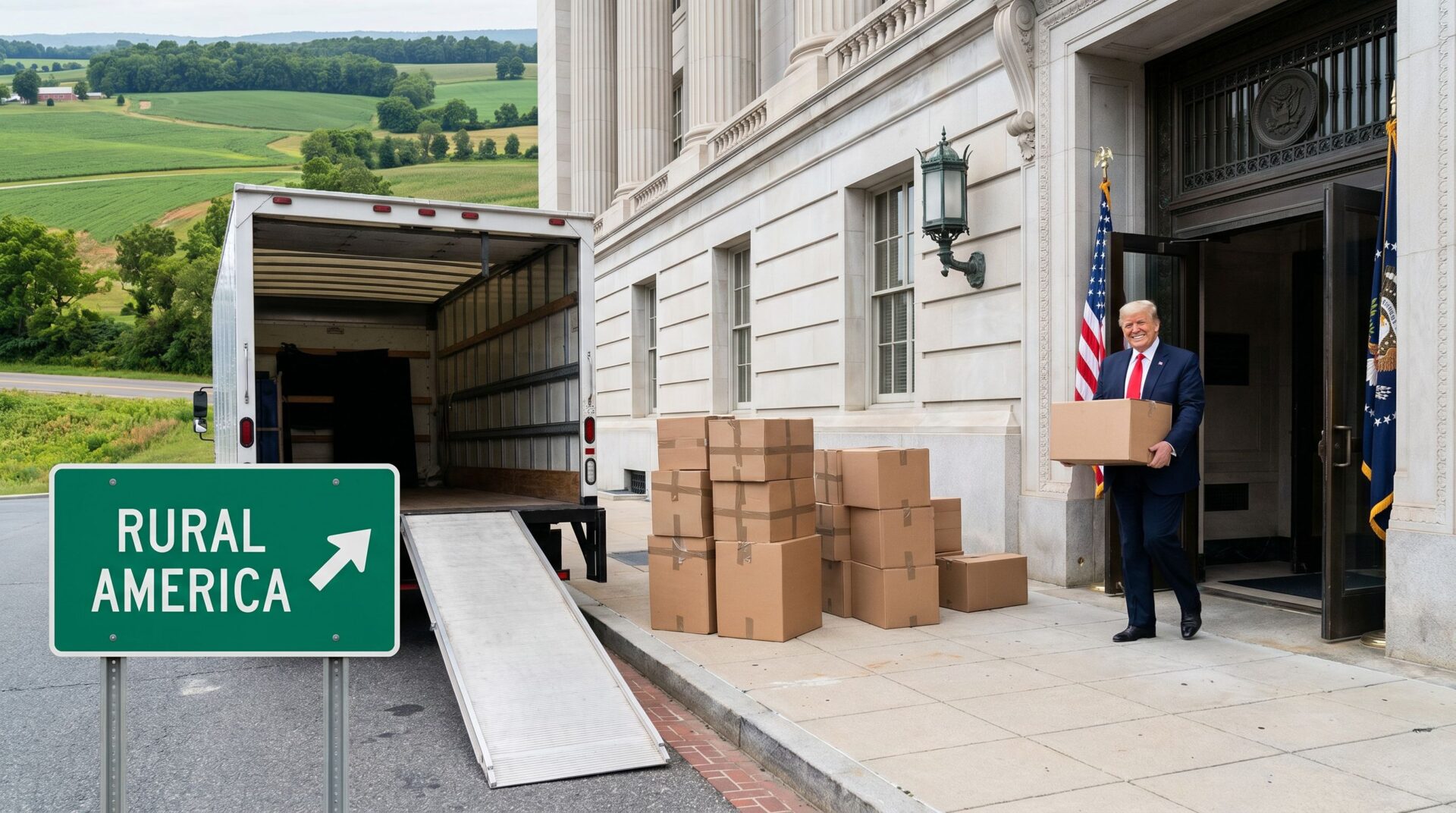
The Trump administration just announced another wave of USDA relocations out of Washington, DC, and if you listen closely, you can hear the collective wailing of desk jockeys who’ve spent their entire careers regulating agriculture without ever stepping foot on a farm. These people write rules about corn subsidies from a cubicle in Foggy Bottom. Now they’re being asked to live somewhere near actual corn. Promise made. Promise kept.
Imagine the scene in the USDA break room right now. Karen from the Office of Rural Development — who hasn’t seen anything rural since a wrong turn on her way to Napa — is staring at a map of Kansas like it’s written in ancient Sanskrit. “But where’s the Whole Foods?” she whispers. “Where’s the Ethiopian fusion brunch spot?” Nowhere, Karen. That’s the point.
Let’s be clear about what’s happening here and why it matters. For decades, the federal government has operated under the assumption that the best place to make decisions about American agriculture, land management, and rural communities is a zip code where the closest thing to livestock is a congressman’s ego. Washington, DC is a city where people pay fourteen dollars for a juice cleanse and think food comes from an app on their phone. These are the people writing your farm policy.
Trump promised during the campaign that he’d move federal agencies closer to the people they serve. Not as a punishment — although watching Beltway lifers Google “what is a tractor” is certainly entertaining — but because it makes basic, obvious sense. The USDA should be near farms. The Department of the Interior should be near, you know, the interior. This isn’t radical. This is what any competent manager would do if they inherited a company where the sales team worked 2,000 miles from every single customer.
But the federal workforce doesn’t see it that way. To the entrenched bureaucracy, a DC zip code isn’t just a mailing address — it’s a status symbol. It’s proximity to power. It’s happy hours with lobbyists and lunch meetings where nothing gets decided but everyone feels important. Moving to Kansas City or Fort Worth means losing the one thing that makes a GS-14 desk job feel glamorous: the illusion that you matter more than the people you’re supposed to be serving.
The union response has been predictable. The American Federation of Government Employees — the same people who fight tooth and nail against any attempt to make federal workers actually accountable — immediately started howling about “disruption” and “institutional knowledge.” Institutional knowledge. That’s a fun phrase. It means “we’ve been doing things badly for so long that we’ve developed expertise in doing things badly, and you should pay us extra for it.”
Here’s what the unions won’t tell you: this has been tried before, and it worked. When the Trump administration relocated portions of the Bureau of Land Management to Grand Junction, Colorado during the first term, the local communities benefited, decision-making improved, and the people writing land use policy could actually see the land they were writing about. Revolutionary concept. The Biden administration, of course, reversed it immediately — because nothing says “party of the working class” like making sure government employees never have to live near working-class people.
The media coverage has been equally absurd. The Washington Post ran a piece that read like a eulogy. Government workers “uprooted.” Families “disrupted.” Careers “thrown into uncertainty.” You know who else deals with uncertainty? Every single farmer in America who wakes up wondering if the weather, the market, or some new regulation dreamed up by a guy who’s never held a shovel is going to destroy their livelihood. But sure, let’s cry for the bureaucrats who have to move to a city with affordable housing and breathable air.
The best part? Many of these employees are being given the choice: relocate or take a buyout. That’s it. Nobody’s being fired into a cannon. Nobody’s being dropped into the wilderness with a compass and a prayer. They’re being offered a government job in a different city or a generous severance package. In the private sector, that’s called Tuesday. In the federal government, it’s apparently a human rights violation.
What we’re watching is something simple and overdue: the federal government being told that it exists to serve the country, not the other way around. DC has become a bubble so thick and so insulated that the people inside it genuinely believe they are the country. They’re not. They’re the help. And the boss just told them to move closer to the job site.
Every farmer, rancher, and rural American who’s ever tried to navigate USDA paperwork from a thousand miles away while the person on the other end of the phone has never seen a soybean should be cheering right now. Your government is finally coming to you. And the only people upset about it are the ones who were perfectly comfortable ignoring you from a distance.
Welcome to America, bureaucrats. It’s big, it’s beautiful, and yes — you might have to learn what a county fair is. You’ll survive.